How Pharmaceutical Companies Use EPCG to Reduce Capital Costs
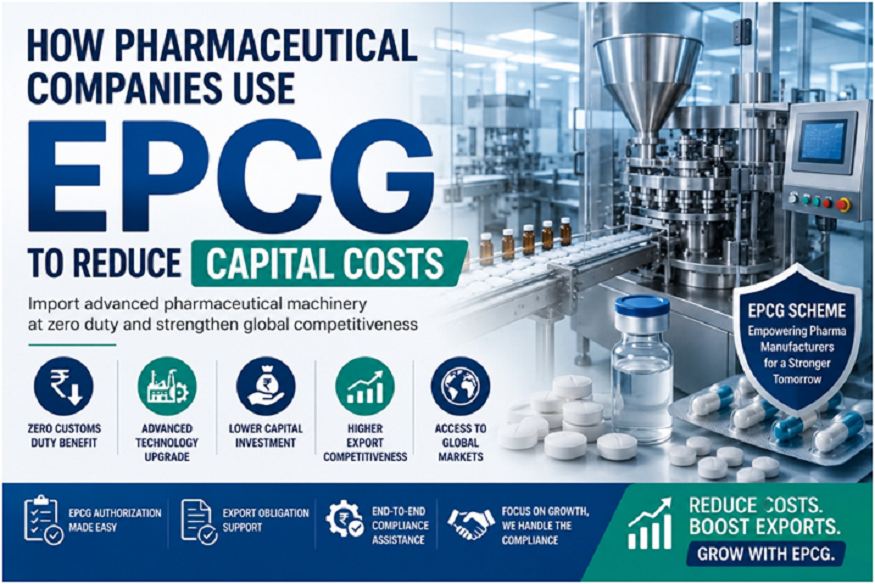
The pharmaceutical industry is one of the largest beneficiaries of India’s Export Promotion Capital Goods (EPCG) Scheme. With pharmaceutical manufacturing heavily dependent on advanced machinery, cleanroom systems, testing equipment, and automation technologies, capital investment requirements are extremely high. The EPCG Scheme helps pharma companies significantly reduce these costs by allowing duty-free import of capital goods against export obligations.
For pharmaceutical manufacturers focused on exports, EPCG provides a strategic advantage by lowering upfront machinery expenses while supporting technology modernization and global compliance standards.
This article explains how pharmaceutical companies use the EPCG Scheme to reduce capital costs, improve manufacturing capability, and enhance export competitiveness.
What Is the EPCG Scheme?
The Export Promotion Capital Goods (EPCG) Scheme is a government initiative under India’s Foreign Trade Policy (FTP) that allows businesses to import capital goods at zero customs duty, subject to fulfillment of export obligations within a specified period.
The scheme is administered by the Directorate General of Foreign Trade (DGFT) and is widely used by export-oriented industries, including pharmaceuticals, chemicals, engineering, textiles, and food processing.
Under EPCG, companies can import:
- Manufacturing machinery
- Production equipment
- Testing and laboratory instruments
- Packaging systems
- Automation technology
- Quality control equipment
- Spare parts and accessories
without paying full import duties.
Why Pharmaceutical Companies Require High Capital Investment
Pharmaceutical manufacturing is highly regulated and technology-intensive. To comply with international standards such as WHO-GMP, US FDA, EU GMP, and MHRA requirements, companies must invest heavily in modern infrastructure and specialized machinery.
Common high-cost pharmaceutical equipment includes:
- Tablet compression machines
- Capsule filling machines
- Sterile manufacturing systems
- Cleanroom equipment
- Fluid bed dryers
- Granulation systems
- Lyophilizers
- Blister packaging machines
- HVAC systems
- Laboratory testing instruments
- Automated inspection systems
Many of these machines are imported from countries such as Germany, Italy, Switzerland, Japan, and the United States, making import duties a major cost factor.
How EPCG Helps Pharmaceutical Companies Reduce Capital Costs
1. Duty-Free Import of Pharmaceutical Machinery
The biggest advantage of EPCG is the exemption from customs duties on imported capital goods.
Without EPCG, importing pharmaceutical equipment may involve:
- Basic Customs Duty (BCD)
- Additional duties
- IGST and related import charges in certain cases
Under EPCG, eligible companies can substantially reduce or eliminate these duty costs.
For large pharmaceutical projects, this can save crores of rupees in initial capital expenditure.
2. Lower Production Setup Costs
New pharmaceutical plants require major investment in:
- Manufacturing lines
- Validation systems
- Packaging units
- Testing laboratories
- Sterile production environments
By reducing machinery import costs, EPCG lowers the total project setup cost and improves return on investment.
This is especially beneficial for:
- Bulk drug manufacturers
- API manufacturers
- Formulation companies
- Injectable manufacturers
- Nutraceutical exporters
- Contract manufacturing companies
3. Technology Upgradation at Reduced Cost
Global pharmaceutical buyers demand strict quality standards and advanced manufacturing capabilities.
The EPCG Scheme encourages pharma companies to upgrade technology by making imported high-end equipment more affordable.
This allows businesses to invest in:
- Automated production systems
- Precision manufacturing equipment
- Digital quality monitoring systems
- High-speed packaging lines
- AI-enabled inspection systems
Technology modernization also improves operational efficiency and reduces wastage.
4. Improved Export Competitiveness
Indian pharmaceutical companies export medicines to highly regulated international markets.
Lower capital costs help manufacturers:
- Reduce production costs
- Improve product pricing
- Increase profit margins
- Expand export capacity
- Compete globally
This strengthens India’s position as one of the world’s largest pharmaceutical exporters.
5. Expansion Into Regulated Markets
Markets such as the United States, Europe, Australia, and Japan require advanced manufacturing infrastructure and compliance systems.
EPCG enables pharma companies to invest in internationally compliant equipment while minimizing import-related financial burden.
This supports certifications such as:
- US FDA approval
- EU GMP certification
- WHO GMP compliance
- MHRA approval
Types of Pharmaceutical Equipment Eligible Under EPCG
Pharmaceutical companies commonly import the following machinery under EPCG:
Manufacturing Equipment
- Tablet manufacturing machines
- Capsule filling systems
- Coating machines
- Mixing and blending equipment
- Reactors and fermenters
Packaging Machinery
- Blister packaging machines
- Bottle filling systems
- Labeling machines
- Cartoning systems
Laboratory & Testing Equipment
- HPLC systems
- Spectrophotometers
- Stability chambers
- Dissolution testing systems
Utility & Support Systems
- HVAC systems
- Purified water systems
- Sterile cleanroom equipment
- Air handling units
Export Obligation Under EPCG
To avail EPCG benefits, pharmaceutical companies must fulfill export obligations within the prescribed time period.
Typically, export obligation is calculated as:
EO=6×Duty Saved Amount
The export obligation period is generally six years.
Exports can include:
- Finished pharmaceutical products
- APIs (Active Pharmaceutical Ingredients)
- Bulk drugs
- Nutraceuticals
- Healthcare products
Companies must maintain proper export documentation and comply with DGFT requirements.
Compliance Requirements for Pharma Companies
While EPCG offers major financial benefits, compliance is critical.
Pharmaceutical companies must ensure:
- Proper EPCG authorization before import
- Installation of imported machinery
- Submission of installation certificate
- Accurate export documentation
- Fulfillment of export obligation
- Timely filing with DGFT
- Maintenance of records for audits
Failure to comply may lead to:
- Recovery of duty benefits
- Interest liabilities
- Penalties
- Authorization cancellation
Common Challenges Faced by Pharmaceutical Companies
Complex Documentation
EPCG applications require detailed technical and financial documentation related to machinery imports and export capability.
Export Obligation Pressure
Companies must carefully monitor exports to ensure obligations are fulfilled within the allowed period.
Regulatory Coordination
Pharma companies often need coordination between:
- DGFT
- Customs
- Chartered Engineers
- Compliance consultants
- Export departments
Delayed Machinery Installation
Installation delays may create compliance complications if installation certificates are not submitted on time.
Why Many Pharma Companies Use EPCG Consultants
Due to complex compliance requirements, many pharmaceutical companies work with EPCG consultants for:
- Authorization application
- Documentation preparation
- Customs coordination
- Export obligation tracking
- EODC closure
- DGFT compliance support
Professional guidance helps reduce compliance risks and administrative delays.
Final Thoughts
The EPCG Scheme plays a major role in helping pharmaceutical companies reduce capital costs while upgrading manufacturing capabilities. By enabling duty-free import of advanced machinery, the scheme supports modernization, export growth, and international competitiveness.
For pharma manufacturers investing in production infrastructure, EPCG is not just a customs benefit — it is a strategic tool for long-term business expansion and global market access.
However, businesses must carefully manage compliance, export obligations, and documentation to fully benefit from the scheme without regulatory complications.